Case Study
Pause Before You Click
A scenario-based phishing awareness module designed to reinforce safe decision-making and the reporting behavior security teams depend on most.
Overview
Pause Before You Click is a short scenario-based eLearning experience built in Articulate Rise 360. Rather than presenting phishing as a checklist of warning signs, the module focuses on how learners evaluate risk signals in context, choose the safest next step, and understand why early reporting matters to the wider team.
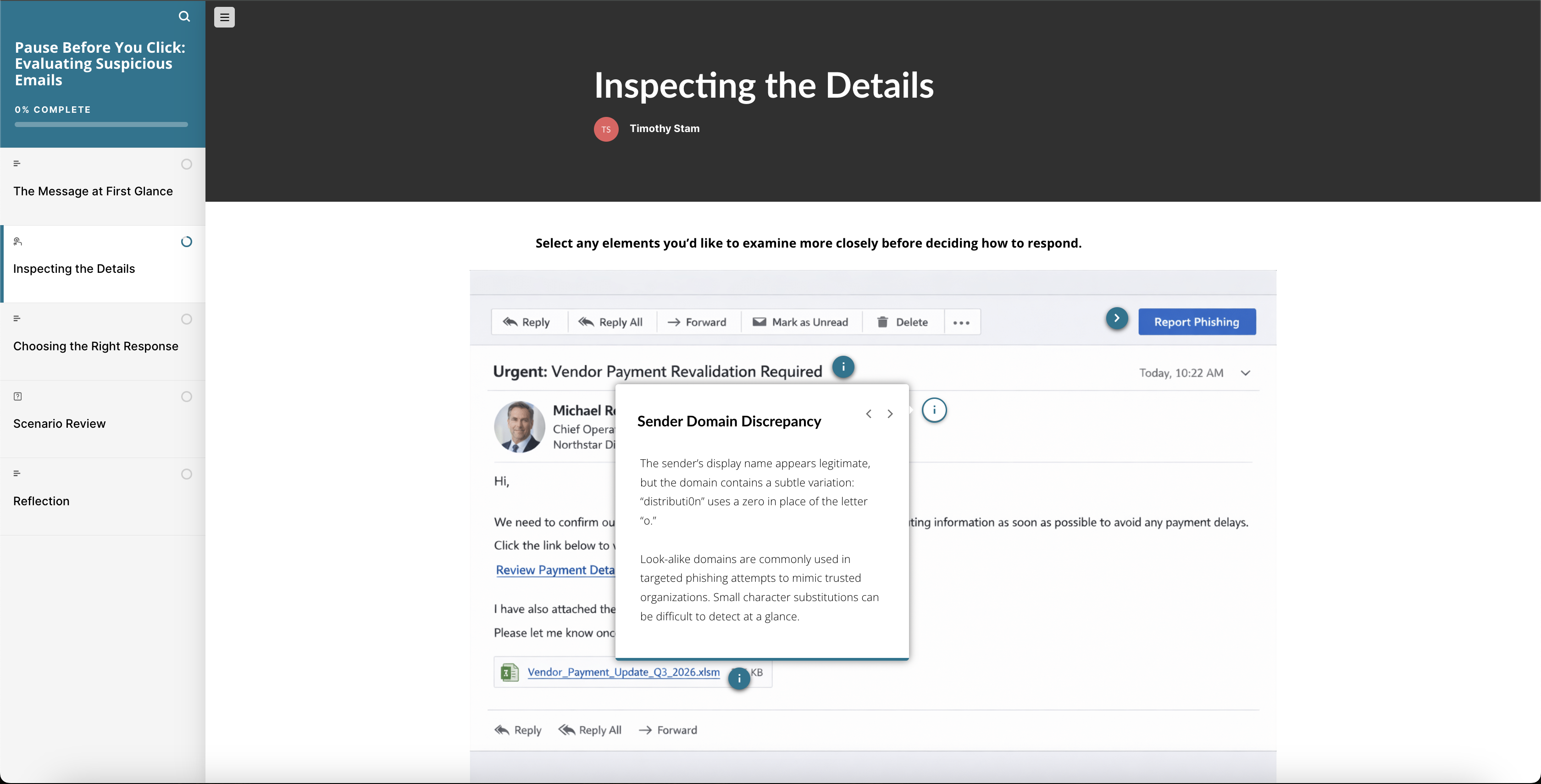
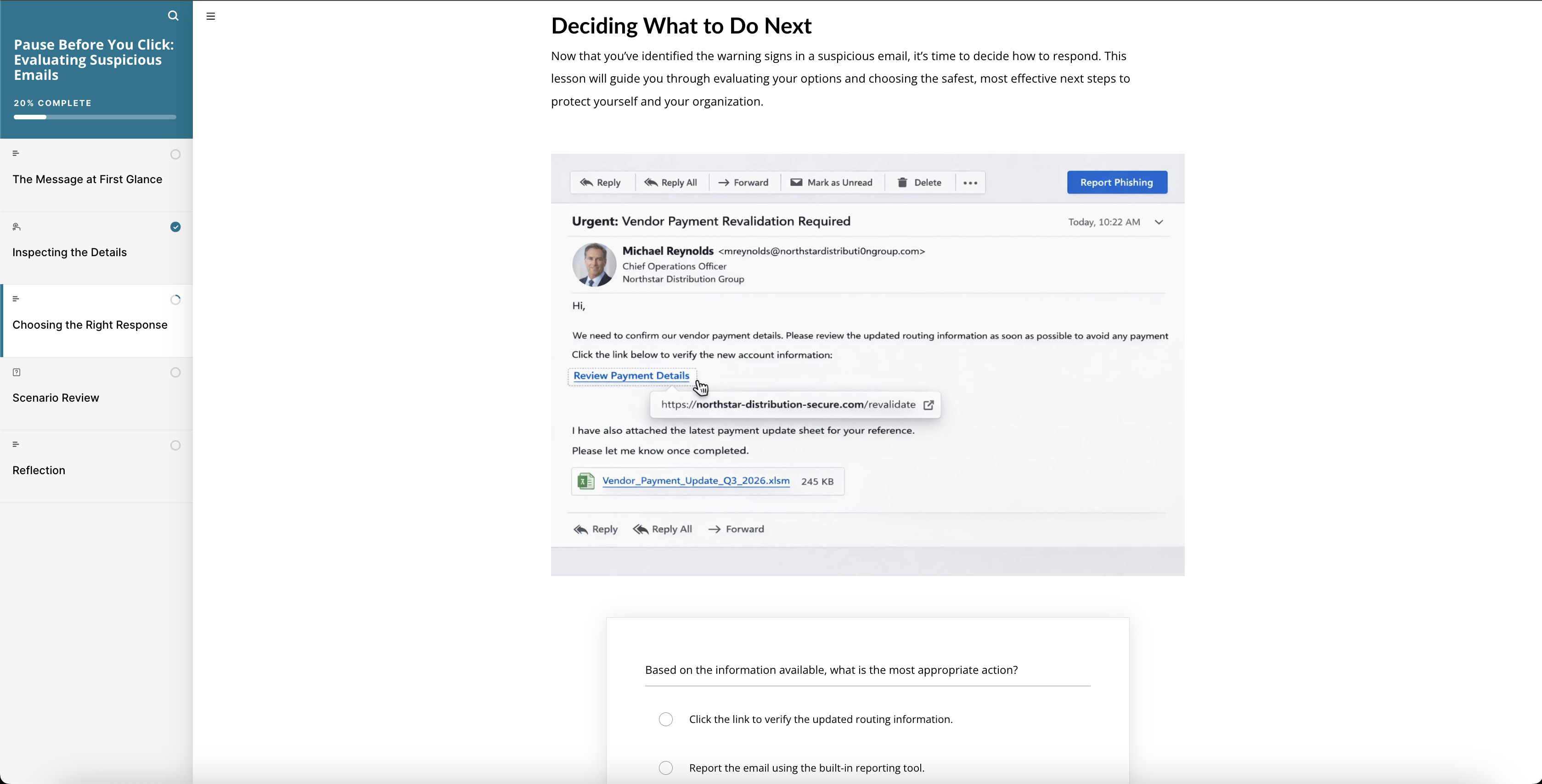
The scenario centers on a realistic business email requesting updated vendor payment information. Learners inspect the message, identify subtle inconsistencies, consider different response options, and complete a short review to confirm understanding.
Challenge
Many phishing-awareness modules focus heavily on recognition but spend less time reinforcing the operational behavior security teams need most: reporting suspicious messages quickly and consistently.
This project was designed to address that gap. It teaches not only how to spot likely phishing indicators, but also why reporting matters, what happens after a report is submitted, and how early action helps protect coworkers from the same attack.
Another challenge was realism. The audience was general corporate employees, not security specialists, so the experience had to feel practical, credible, and useful under normal workplace pressure rather than technical for its own sake.
Approach
I designed the module as a short decision-based experience rather than a content-heavy awareness lesson. The learning flow intentionally moves through four stages:
- Observation — learners inspect the email before being told what is suspicious
- Analysis — interactive hotspots reveal specific indicators, such as a subtly altered sender domain and a mismatched destination URL
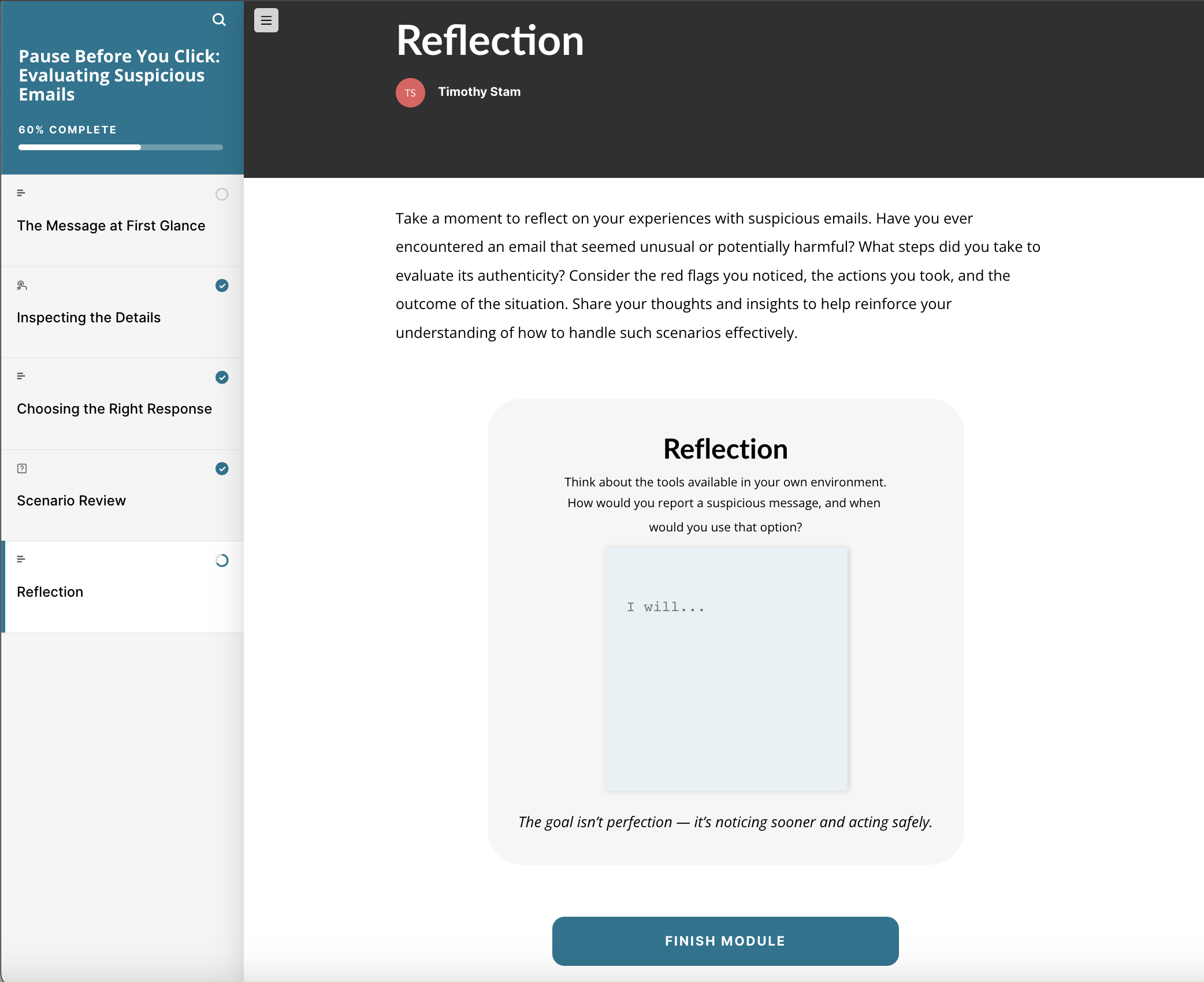
- Reinforcement — a low-stakes decision point connects individual action to broader team protection
- Verification — a short required review confirms that learners can recognize the strongest indicators and choose the safest response
This structure was meant to mirror how phishing is actually encountered at work: see the message, inspect details, decide what to do, and ideally report before others are affected.
Key Design Decisions
- Use realistic technical indicators. The scenario avoids older, more obvious phishing tropes like poor grammar or generic greetings. Instead, it uses more current indicators such as a subtle sender-domain misspelling and a destination URL that does not match the organization’s domain.
- Center reporting as the target behavior. Reporting is not treated as an afterthought. The experience reinforces why it matters operationally: it helps security teams investigate active threats, block similar messages, and reduce the chance that others on the team will be affected.
- Keep assessment calm and professional. The final review is required for completion, but it is framed as confirmation of a safe response rather than as a quiz competition.
Platform Choice
The module was built in Articulate Rise 360 to create a clean, modern, quickly deployable learning experience that could be easily updated and reused. Rise was a strong fit here because the goal was behavioral reinforcement, not deep branching or simulation-heavy complexity.
It supported the project well through structured lesson flow, labeled graphic interactions, accordion content for process explanation, and lightweight scenario review and completion tracking. It provided enough interactivity without unnecessary production overhead.
Outcome
This piece demonstrates how I approach technical and security-related learning design: translating risk concepts into realistic workplace decisions, building around behavior rather than awareness alone, and using short-form scenarios to reinforce operationally meaningful actions.
It also shows how I balance realism, clarity, and platform constraints without overdesigning the experience.
Selected Screens