Case Study
Automation Operator Training Program
A training program designed to support operational readiness for automated packaging equipment in a high-throughput fulfillment environment, combining sequenced orientation, procedural reinforcement, and simulation-based practice before live deployment.
Overview
This training supported operational readiness for automated packaging equipment in a high-throughput environment. The goal was to ensure associates could execute critical equipment workflows accurately and consistently prior to live deployment.
The design emphasized procedural sequencing, system awareness, and applied practice to reduce operational risk during production ramp. Rather than relying on shadowing or passive instruction alone, the learning experience was structured to mirror how work actually unfolds on the machine.
Challenge
Automation training has to do more than explain machine features. It has to prepare learners to act correctly in sequence, under real operational conditions, where incorrect task order can lead to jams, mis-scans, safety issues, or downstream disruption.
The learning design challenge was to create a path that moved learners from orientation into procedural confidence and then into applied execution, while still being scalable enough for rollout needs and sensitive to changing equipment behavior, production milestones, and deployment timelines.
Approach
I designed the program as a staged progression aligned to the real operational lifecycle of the machine. Instead of treating training as a flat collection of topics, the curriculum moved learners through a sequence that reflected the work itself:
- orientation, safety, and machine/system awareness
- procedural reasoning and task sequencing
- interactive practice and simulation
- exception handling and readiness for live execution
This approach matches the broader design philosophy reflected across my technical training work: establish the mental model first, model the workflow, provide guided practice with feedback, and then require applied execution. The aim is transfer to real performance, not just recognition in a training environment.
Solution
The final experience included three main evidence layers:
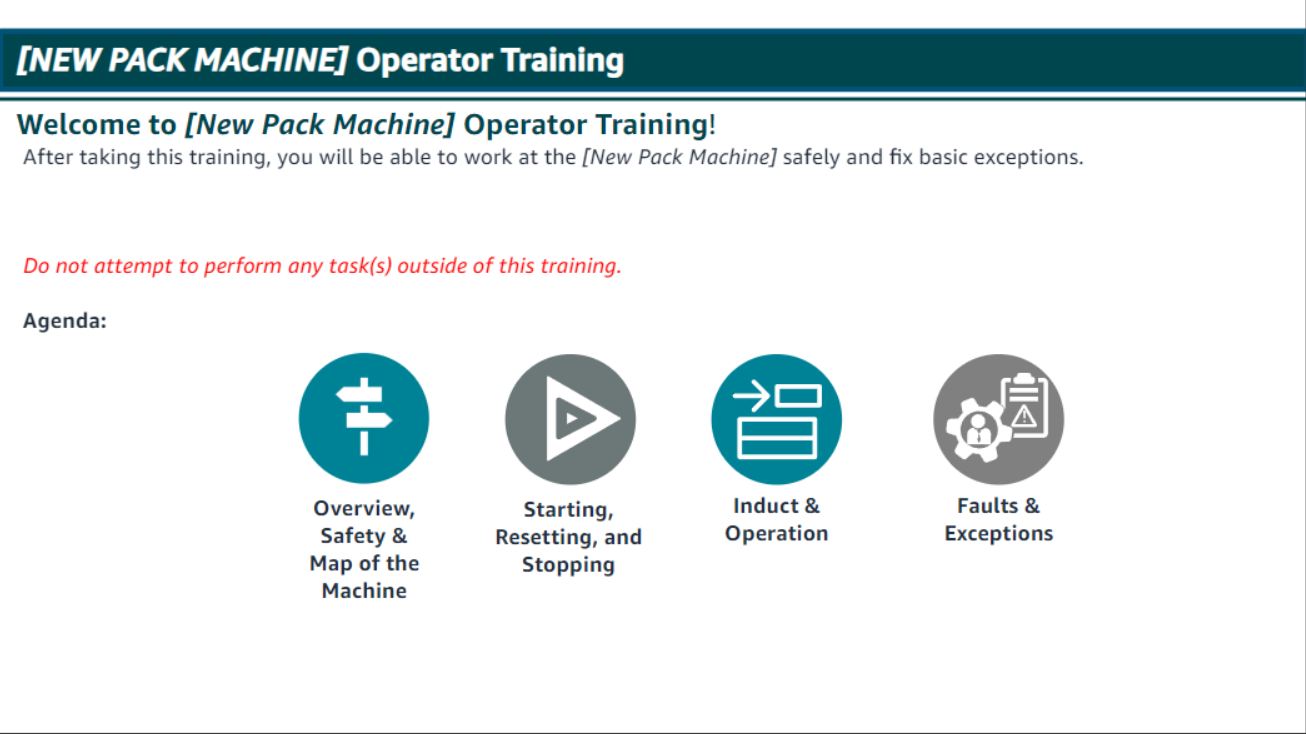
- Course architecture — a sequenced learning path aligned to real operational workflow
- Procedural reinforcement — drag-and-drop step validation for task sequencing
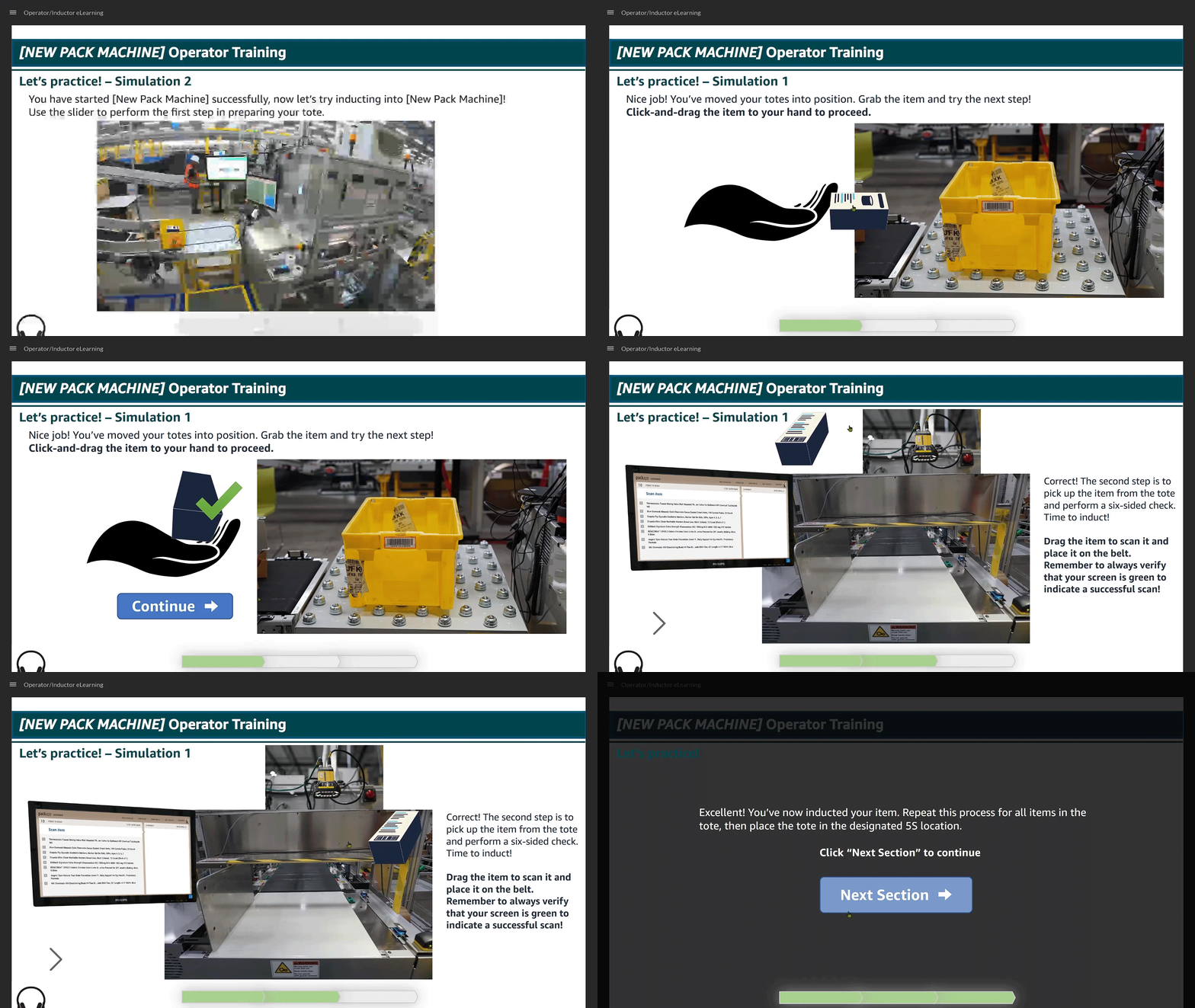
- Interactive simulation — applied task performance and decision reinforcement
The course architecture was intentionally sequenced to mirror the machine’s lifecycle, moving from safety and orientation into startup, induct operation, and exception handling. Progression was gated so learners moved through content in order before revisiting sections after mastery.
The procedural reinforcement activity required learners to correctly sequence each step of the induction workflow before progressing. This shifted validation away from recognition-based answers and toward full task-order understanding aligned to live equipment behavior.
The simulation required learners to perform the induction process in sequence by selecting an item, scanning it correctly, and placing it on the belt. Advancement depended on correct execution, reinforcing the relationship between operator action and system response. That structure provided structured rehearsal prior to production exposure rather than relying on shadowing alone.
My Role
I owned curriculum design and maintenance for the automation equipment training and aligned it to real production workflows and deployment timelines.
- translated complex equipment behavior and system logic into structured, role-specific learning experiences for frontline operators and leaders
- designed applied practice elements, including ordered-step validation and interactive workflow simulations, to reinforce execution accuracy prior to live deployment
- architected a staged learning progression to reduce operational risk
- partnered with operations, engineering, and launch stakeholders to validate technical accuracy and reflect equipment updates
- aligned training deliverables to ramp milestones and production requirements
- developed scalable Storyline-based assets supporting both instructor-supported and self-paced delivery models
Outcome
This project demonstrates how I design for operational transfer: starting with the work learners must actually perform, then building only the concepts, sequencing, and practice needed for reliable execution under real conditions.
It also shows how I use interactivity intentionally. The drag-and-drop activity and simulation were not added for novelty; they were designed to reinforce procedural accuracy, consequence awareness, and staged competency before hands-on execution.
Selected Screens